Given the hyperconnected digital world we live in today, cyber incidents are no longer if, but when. 47% of businesses experienced more than 10 breaches in 2023. So, whether it is a ransomware attack, outage of a system, corruption of data, or an all-out natural disaster, today’s organizations should be ready to act and react quickly. But here’s where many businesses get stuck:
- Which should we activate first: Incident Response, Disaster Recovery, or Business Continuity?
- Are these the same thing or different?
- Do they overlap with each other?
- Which team handles what?
This confusion often delays actions, prolongs downtime, causes financial losses, and irreparably damages brands. To take the guesswork out, this guide breaks down incident response vs. disaster recovery vs. business continuity. Understand what they mean, why each one matters, and how to build a strong resilience strategy using all three.
“By failing to prepare, you are preparing to fail.”
— Benjamin Franklin
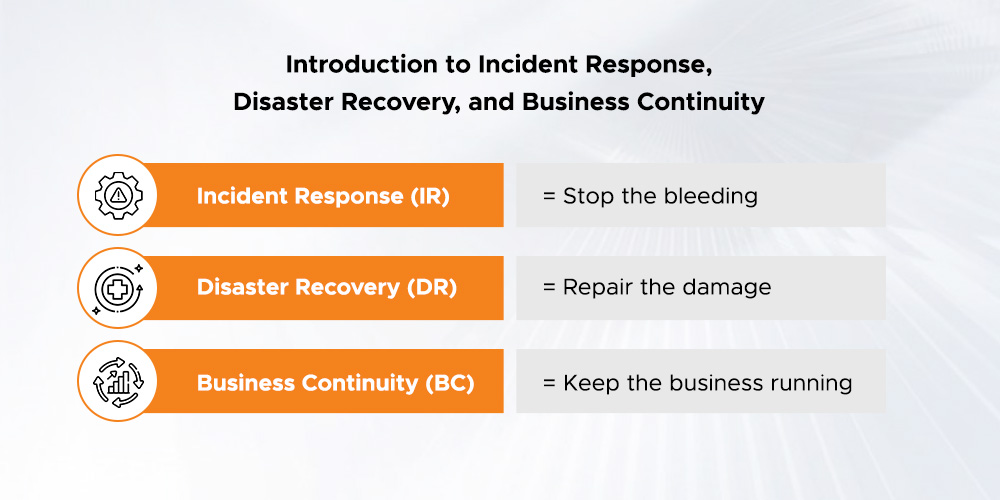
Introduction to Incident Response, Disaster Recovery, and Business Continuity
Every single cybersecurity incident affects your business differently. Some will impact your data and others your systems and operations. Think of the three processes as your defense layers. Together, they form a complete resilience ecosystem, helping organizations prepare, respond, recover, and operate without major disruption.
What Is Incident Response?
IR is the immediate, tactical approach to detect, contain, and eliminate threats. Incident response deals with cyber incidents, such as ransomware attacks, malware outbreaks, access by unauthorized persons, data breaches, insider threats, and zero-day exploits. This is where real-time incident response, quick decision-making, and the speed of execution matter most.
Goals of Incident Response
- Cease the attack immediately
- Contain the threat
- Avoid further damage
- Initiate cyber threat remediation
- Restore the affected components quickly
- Document evidence for compliance
Example of Incident Response
A finance company experiences unusual outbound traffic. IR teams rapidly identify a malware beacon. They then isolate affected systems, block malicious IPs, remove the malware, and restore the affected workstation. The attack is neutralized before sensitive data leaves the network. This is fast, targeted, and precise, the essence of incident response and recovery.
What is Disaster Recovery?
Once the threat has passed, you need to enter the phase of DR. While IR is tactical, disaster recovery management is more operational. It is aimed at restoring infrastructure, servers, databases, applications, cloud platforms, and backups. DR ensures that IT systems return to functional status after an interruption.
Goals of Disaster Recovery
- Recover mission-critical applications
- Restore data from backups
- Rebuild compromised systems
- Meet uptime objectives: RTO/RPO
- Reduce financial loss
Example of Disaster Recovery
A ransomware attack encrypts the company’s main server. With the help of the DR team, the business wipes infected servers and restores clean backups after checking file integrity, then resumes operations. This is the core of cyberattack recovery and post-incident analysis.
What Is Business Continuity?
While IR and DR address mainly the IT systems, business continuity risk assessment addresses the organization as a whole. BC ensures that all necessary operations of the business continue, even under adverse conditions. Business continuity maintains critical customer service and supply chain management functions throughout the organization.
Goals of Business Continuity
- Maintain operations during disruptions
- Safeguard revenue and customer trust
- Enable alternative business processes
- Minimize the impact of downtime
- Ensure workforce productivity
- Focus on organizational resilience
Example of Business Continuity
A fire disaster disables a company’s main office. With business continuity risk assessment, employees work remotely, customer support moves to the cloud, operations continue from backup locations, and the business keeps running even as the building does not. This is the power of combined business continuity and disaster recovery.
| Area | Incident Response | Disaster Recovery | Business Continuity |
|---|---|---|---|
| Purpose | Stop the threat | Restore systems | Keep business operational |
| Scope | IT Security | IT Infrastructure | Entire organization |
| Focus | Detection, containment, remediation | Data and system recovery | People, processes, communication |
| Teams Involved | SOC, Security, Forensics | IT Ops, Cloud Teams | Leadership, HR, Ops, IT |
| When It Starts | Immediately during an attack | After threat is removed | During or after disruption |
Why Do You Need All Three for Modern Cyber Resilience?
Modern cyberattacks are more sophisticated than ever. Threats now combine ransomware, data theft, and cloud security intrusion. Thus, a single attack can bring down not just systems but whole business operations. Here’s why organizations need to integrate incident response, disaster recovery, and business continuity to ensure cyber resilience:
- Reducing downtime: Every minute of downtime costs money. This is where the strong BC–DR–IR model reduces operational disruption dramatically.
- Minimizing reputational damage: Customers expect continuous service. Continuity keeps operations alive—even in chaos.
- Meeting compliance requirements: Critical industries like finance and healthcare need documented IR/DR/BC plans for regulatory compliance (GDPR, HIPAA).
- Enabling faster cyberattack recovery: Without formal protocols, businesses waste critical hours deciding “what to do next.”
- Avoiding recurrence of the incident: While IR closes gaps, DR restores systems, and BC strengthens resilience. Together, they remove any potential online attacks.
How Does SecureSmartz Help Build a Complete IR–DR–BC Strategy?
At SecureSmartz, we have been helping businesses reinforce their cyber resilience strategy for more than 26 years now. We make sure that no matter what hits, your business stays resilient 24/7. The following gives a more detailed look at how SecureSmartz helps enterprises implement a mature, scalable, and actionable IR–DR–BC framework:
-
Rapid Incident Detection and Response
We use real-time managed detection and response, 24/7 monitoring, and automated incident response playbooks that let you contain any threats before they scale. Our incident response team leads the charge on rapid cyber threat remediation to minimize damage and downtime.
-
Structured Disaster Recovery Planning
SecureSmartz builds clear cyberattack recovery plans with defined RTOs/RPOs, validated backup mechanisms, recovery runbooks, and environment restoration workflows. This helps us ensure that your systems come right back up.
-
Business Continuity and Risk Assessment
We perform an enterprise-wide business continuity risk assessment, identify operational vulnerabilities, and design resilient continuity processes, redundancies, and communication plans. This keeps your business running under any disruption.
-
Unified Strategy, One Partner
SecureSmartz provides you with one integrated and straightforward resilience framework that enhances security while reducing operational risk. We will help you integrate incident response and recovery, disaster recovery readiness, AI-driven cybersecurity incident response software, and long-term continuity planning.
Understanding the nuances of incident response vs. business continuity vs. disaster recovery is vital for any industry or business. Organizations that plan holistically, invest in real-time detection technologies, and continuously update their response and recovery frameworks can protect themselves against evolving threats in the face of adversity. So, are you ready to ensure cyber resilience for your organization?
Frequently Asked Questions
IR handles cyberthreats.
DR restores systems.
BC ensures business operations run without glitches.
Survivability
Regulatory compliance
And continuity of business operations.